


Writings — Thesis, 2025
The Immersive Experience: Histories and Bodies Between the White Cube and Black Box
Abstract
We have seen a recent rise in a nascent but rapidly common form of art containment, known as an ‘immersive experience’. In its historical baggage, it emerged in-between the double helix of the ‘white cube’ and ‘black box’ in an awkward position, rejected by both the institutional values of the white cube and the black box, almost like their bastard son. In this relatively new area concerning the immersive turn, Bishop has most critically positioned the immersive experience as a ‘gray zone’, explicitly focusing on dance performances that are still within the museum (2018, p. 23). Rather than starting from a technological definition of immersion, I approach it as an evolving cultural construct produced through negotiations between bodies, images and the architectures that hold them.
Contents
Introduction
It seems that art critics and historians have been careful in positioning the immersive experience as an art experience due to its strong associations to mass entertainment and the more economic realms of the experience economy. The more visible examples such as the Vincent van Gogh Immersive Experience Franchise (2017) have met its vicious art critics who have attacked its fundamentally spectacular conditions (e.g. Desplanque, 2025). As a result, this new and vague form of art containment has mostly been studied for its benefits and potential in museum studies (Shehade & Stylianou-Lambert, 2020), especially in its deconstructed components of Extended Reality technologies (XR) (e.g. Vi et al.,2017; Kwon, 2025), or through the technological and historical lens of Human Computer Interaction (HCI) (Zhou, 2024), exemplified by Prix Ars Electronica’s introduction of ‘interactive art’ as a formal discipline in 1990 (Kwastek, 2013).
In response to this context, this paper is concerned with tracing the histories and origins of the modern ‘immersive experience’, an increasingly ubiquitous art form or containment. Whilst it has entered the public eye through appearances both inside and outside of formal gallery or museum spaces, the purpose of investigating the new media has remained vague in the realms of formal art history. As such, this paper attempts to evolve understandings of the vague histories of the ‘immersive experience’. This paper begins with a strict zoning that separates the histories of the ‘white cube’ and ‘black box’, in order to draw on relevant ideologies that contribute to the evolution of the ‘immersive experience’. Through carefully selected cases from the late 1950s onwards, this paper hopes to identify the themes that evolve and transgress into our modern age. Then, it takes a sharp turn back to more recent examples of the ‘immersive experience’, in order to highlight the new ideologies that emerged from in between. Notably, the contemporary examples selected are restricted to those I have visited physically in order to engage first-hand research of the immersive qualities, with the exception of Pipilotti Rist’s Your Palm is My Universe (2025).
Section 1: The White Cube
As the late 19th Century started to depart from the Paris Salon style hanging, the canonical display of art witnessed an architectural and esthetic evolution that increasingly favored spacious white walls in the creation of a singular and interrupted focus. Today, the teleological endpoint of this evolution has culminated into a predominantly pristine ‘white cube’, replacing its predecessors as the standard vitrine of contemporary art. When one enters Bermondsey White Cube, London, one cannot ignore the rational order that constructs the space: The ordered white lights speak of precise shadows, designed to separate the work from contexts of outside space and time. Within the gallery’s 2025 display of the prolific late sculptor Richard Hunt’s 30 major works, the absolute whiteness literally makes us forget that metals rust and leave unwanted shadows and stains. This white cube is one that casts away its own shadows or historical baggage, in the telling of a fictional neutrality whereby nothing interferes with the art it frames.
The white cube has been both loved and maligned. On the one hand, the white cube plays a critical position in turning art visible; Justifying the social roles and demands of something increasingly as abstract as art itself. Yet, it imposes artistic conventions and behavioral demands over how art is contained, controlled and consumed. In relation to the wider environmental and aesthetic changes witnessed most prominently in the late 1950s and 60s, Allan Kaprow’s 18 Happenings in 6 Parts (1959) marks a significant turn to how artists and intellects in that contemporary began wildly gesturing against institutional sensibilities imposed by the white cube. Inside the Reuban Gallery, New York, Kaprow constructs a temporary space divided into three rooms using cheap materials, and the audience is demanded to participate as obedient students who would strictly abide by his instructions to move, to act, to behave. By undermining the imminence of formal art conventions using the medium of Modernist art pedagogy, Kaprow indicates the role of art in negotiating the conventions surrounding art, that “art itself could simply become art criticism” (Capper, 2025).
Critiques of the white cube are most seminally echoed through O’Doherty’s Inside The White Cube (1999), originally written in 1976. Written by someone who was both a theorist and practitioner, Sheikh argued that O’Doherty’s most revisited texts exceed art history as the artist’s autobiography (2009). Indeed, the text should be read not as mere critique but also through the lens of the immemorial and ongoing negotiations between new means of art containment and the ‘what’, ‘who’ and ‘how’ it contains in relation to the artist. As Sheikh points out, O’Doherty’s discourse “is simple, just as much as it is radical” (2009, p. 1): The white cube is not a neutral container, but an ideology and historical construct that makes the work inside it appear self-contained. Using the analogy of a secular church that is “untouched by time and its vicissitudes” (O’Doherty, 1999, p. 15), the white cube constructs a timeless quality for the politics and commercial logic it feeds. It does so by immortalizing the values of a certain class or taste, staging art as objects for investments. As such, the white cube transcends its carefully painted walls as an institutional pursuit for eternal class stability.
Although O’Doherty’s critique is directed towards the institution, he also unveils how ‘technology’ - through a broader, Foucaultian sense of institutional and ideological apparatus - is manipulated to discipline the body in a gallery environment. He calls this the “technology of esthetics” (O’Doherty, 1999, p. 15). By entering this secular church, the whole ‘body’ with emotions and perceptual cues – whom he calls the ‘Spectator’ – must die before he enters, in favor of the disembodied ‘Eye’. The eye symbolizes how the ideal visitor of the white cube should be highly cultural and possess knowledge of formal art principles, reinforcing the commercial logic of the embedded ideology. In other words, even if you don't know art, you must pretend to know it or otherwise know someone who does, as O’Doherty humorously implies (1999, p. 41). This technological control, then, is built upon a sense of self surveillance that one is programmed to be accustomed to when entering this artificially religious place. This is epitomized by ‘The Installation Shot’ of mainstream Modernism, a specific photographed composition where the Spectator is absent and the focus is on the container of the uninterrupted ‘what’ and ‘how’. As a result, the picture plane exclusively preserves the formal art qualities judged only by the Eye (O’Doherty, 1999, p. 42). As such, the white cube’s ideology is necessitated upon tensions between the body and technology, whereby its essentially religious nature dictates and imposes behavioral demands.
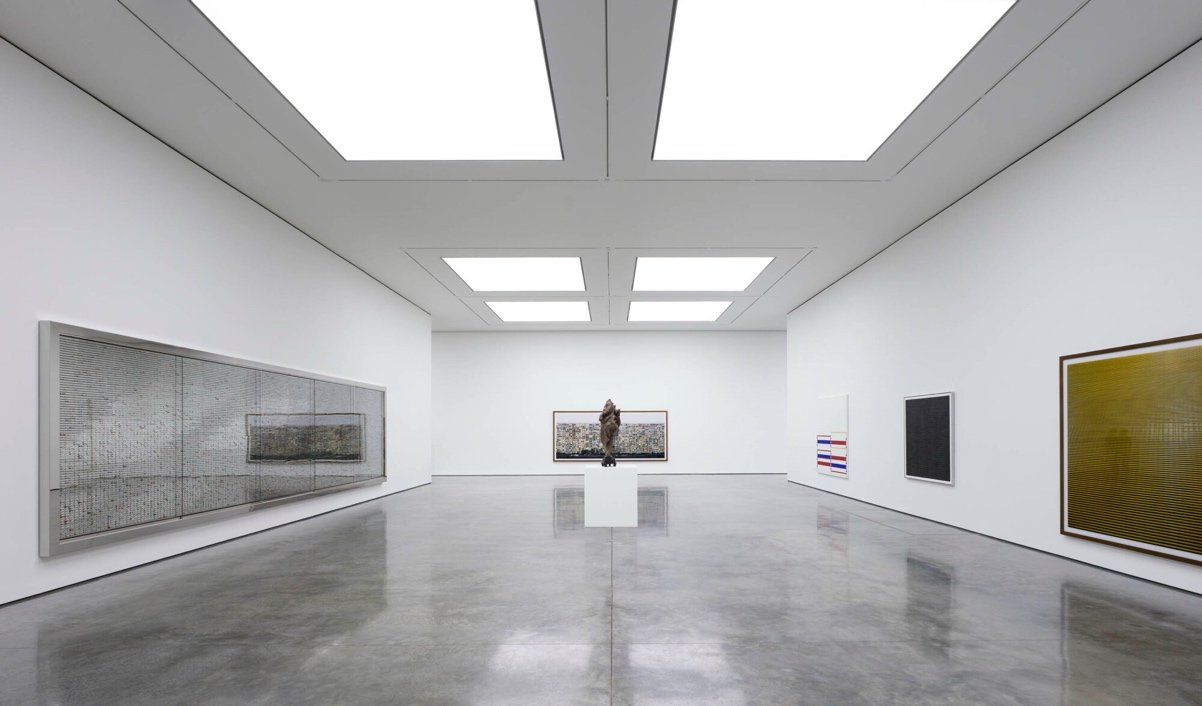
As previously argued, the relevance of O’Doherty’s critique today lies in deciphering the continuously evolving means of art containment. This negotiation exceeds the environmental and esthetic condition as noted by Kaprow’s 18 Happenings(1959), into negotiating tensions between the body and technology as noted by O’Doherty’s description of the Installation Shot. To see how these negotiations between body and technology materialize in practice, I now turn to a contemporary site that critically stages them: the immersive experience.
Section 2: The Immersive Experience
The true wonder of the contemporary immersive experience is perhaps most vivid when the phenomenological brain convincingly fails to discern the immediate reality from illusion. A simple relationship between the mind and the space becomes complex (Crary, 1992), or by Foucault’s terms there is an engineered tension between “the arrangements of bodies and space” (1977). This has been my experience visiting the teamLab Borderless Tokyo, Azabudai Hills (2024). As the observer enters through the corridor and then further underground into a dark space, they find themselves inside an estranged environment, one that is neither a gallery nor a cinema in its known sense.
The immediately confronting factor, is the illusion of your physical body being transported into a floral, cosmic void through accurate projection mapping technologies well implemented onto the cube’s surfaces. As the petals flow and wander, along the walls and under your stance from every stretching direction, the attentive mind feels as if it is ‘actually’ there and transported into this dreamscape, a spatialized psychic scene. This scene is further convinced through scale as a physical device, as the moving ‘wallpaper’ shifts and changes through the 7,000 m² of coverage, allowing the observer to experience a collection of moving ‘traumlandschaft’ (Freud, 1900). Can the mind experience so much at once? Each divided space anchors a distinct theme or technology, disrupting the mind from one fragmented perception immediately to the next. Achieved, is a schizophrenic spatial effect that further convinces the observer’s mind the illusion of their objective presence in this increasingly overwhelming and truncating sensory overload, as each corner gauges their immediate attention through motion, light or sound.
En Teahouse (teamLab, 2024) is a key exhibit that highlights how interactive technology in our age challenges the brain’s attempts to distinguish reality from illusion. This dark room is essentially a resting space or café, where the observer enjoys slightly pricey tea in a space mocked up on a reimagined traditional Japanese tea ceremony. When the tea comes served in a ‘chawan’ or tea bowl, a strange site appears: a projected flower accurately traces the edges of the bowl and burns onto the image plane, slowly blooming from its initial bud to a full blossom. This esthetic translation postpones the Western observer’s usual mindless act of consuming a beverage and reminds them of the ephemeral present, digitally embodying the philosophy of the Japanese tea room. As the observer picks up the chawan and drinks from it, the physiological response is one conflated with a gustatory and somatosensory illusion. The mind subtly expects the flower to ‘actually’ be a part of what is being tasted, which would accompany a soft texture and floral aroma. This illusion is, of course, instantly juxtaposed by the usual flavors of the Japanese tea and the observer’s rational understanding. Despite the obvious understanding that there is no flower in the tea, the subjective mind dislocates from a lap between illusion and reality, thus challenging how idiosyncratic knowing is manipulated through what Uroskie refers to as ‘spectatorial double consciousness’ (2014, p. 35).
Crary has detailed how this illusion between vision and mind has long evolved since the early 1800s inside his seminal text of Techniques of the Observer(1992). During this period, a physiological shift proposed a radical narrative: that human vision is an unstable internal phenomenon, rather than an objective and universal truth that has long been recognized through the ‘assemblage’ of the camera obscura (Crary, 1992, p. 16). To artists, this means that the vision can be controlled to change the observer's experience. This is exemplified by Turrell’s Ganzfelds that use light technologies to destabilize the depth of field within the subjective vision, causing the observer to be overwhelmed or loose sense of space. This control element is what Crary has famously argued: If vision is subjective and empirically quantified, then the body or ‘Observer’ becomes “an object of investigation” that can be studied and controlled (1992, p. 16).
Unlike O’Doherty’s ‘Spectator’ who is positioned and disciplined by the hidden demands of the white cube, Crary’s ‘Observer’ is engineered by manipulation of the subjective vision, programmed to see only through the designed codes. As Crary (1992) warns, new technologies after the ‘philosophical toys’ continue to discipline the body and further regulate it for intended purposes, “computer-aided design, synthetic holography, flight simulators, computer animation, robotic image recognition, ray tracing, texture mapping … increasingly these emergent technologies of image production are becoming the dominant models of visualization according to which primary social processes and institutions function” (Crary, 1992, p. 1). This is immediately instanced by the earlier example inside teamLab’s Borderless, whereby Goethe’s (1810) principles of the afterimage burn, subjective colors and phenomenal color mixing suggests that the physiology of sensory overload can be designed, engineered and controlled. In the context of the immersive experience, it is important to understand that technological advances continue to codify the body for efficient consumption.
Before we travel back into the position of the ‘black box’ in relation to the immersive experience, it is significant to note that teamLab declares its works as art, thus making its containing environment a deliberate art container, just like the white cube1. On the walls of the entering corridor, the welcome text reads: “teamLab borderless, has no maps or routes. Some of the rooms are hard to find, artworks leave rooms, move through the halls, and enter other spaces. The artworks in a room change overtime, try returning to the same room after a while. Enjoy this continuous borderless world.” (teamLab, 2024). Of course, one may argue that the use of the word ‘art’ should be interpreted as a commercial gimmick rather than a formal proclamation, especially due to its emergence outside of the Eurocentric art canon.2 However, it may serve meaningful to contemplate the conditions imposed by teamLab as nascent art container in our globalized world of immediate exchange, where the individual genius dissolves into collective form, and art can become introduced outside of the white cube as global, connected experiences as long imagined by VanDerBeek.
Section 3: The Black Box
Developed in parallel to the white cube’s institutional critiques around the 1960s, the cinema also witnessed an intellectual shift whereby artists and those working with the moving image began to challenge the environmental conditions of display, emerging the expanded connotations of the ‘black box’ (Uroskie, 2014). Recall the last time you were placed in this site: As one enters the cinema, the body walks through the aisle and then surrenders its mobility, sits in silence orderly to the neighbouring unfamiliar body, facing in front of it a singular white screen that commands its entire attention. Like the white cube, the black box speaks of a site-dependent ideology that predetermines and controls the body’s aesthetic encounter through a classical model of spectatorship.
A key part of the black box’s historical context addresses the role of new consumer technology in changing how media is consumed. In particular, the invention of the television has been linked to a significant drop in movie tickets sales from 1946 to mid 1960s, reflecting a milieu where an increasingly fragmented consumer audience deprives the traditional black box of its authority (Williams, 1974). To contemporaries of Andy Warhol, image or media consumption became an intimate and fragmented experience within one’s home, as temporal linearities of scenes would become disrupted by advertisements during broadcasts. This undergirds the key tension within a generational shift: Classic film makers like Alfred Hitchcock (1960) stretches participatory conditions and site control extensively to establish a hyperbolic defense, whilst the rising contemporaries of image makers and artists began to violently denounce the traditional models that ranged from before their times. Between 1959 to 1971, John Mekas’s "Movie Journal" column in the Village Voice offers a critical perspective documenting how household names began to challenge and destabilize the medium from the underground up (1972). Amongst which, his entries concerning Andy Warhol’s five-hour documentation of his then sleeping lover John Giorno sleep (1963, 1964) expands the artist’s anti-film concept into this collective consciousness that questioned what film is, expanded into what it can be; “Is Andy Warhol really making movies, or is he playing a joke on us?—this is the talk of the town. To show a man sleeping, is this a movie?... If it is not cinema then what is it? What is it a forecastof?” (Mekas, 1963, p. 125).
The culmination of Mekas’s much contemplated forecast, of course, cannot be separated from Youngblood’s seminal work of Expanded Cinema(1970), rooted within the context of the late 1960s West Coast counterculture. It was in part the earlier implementations of the destabilization of the film medium that pushed Young to imagine film as beyond commercial entertainment, foreshadowing the modern immersive experience and the potentialities of our new media ecosystem. It was, as founder of Light Industry Brooklyn Thomas Beard (2023) argues, a “science fiction [that forecasts] the primitive beginning of an epochal changeover in human-machine dynamism, wherein the imperatives of art and science have become inseparable”. Transcending even beyond medium or site (Uroskie, 2014), Youngblood argues that the black box mediates unforeseeable evolutions of the possibilities of humanity after the Industrial age. This is reflected in terms of what he coins as the ‘Paleocybernetic Age’ - whereby intermedia or cybernetics expand the body and “man’s communicative capacities beyond his most extravagant visions” (Youngblood, 1970, p. 41).
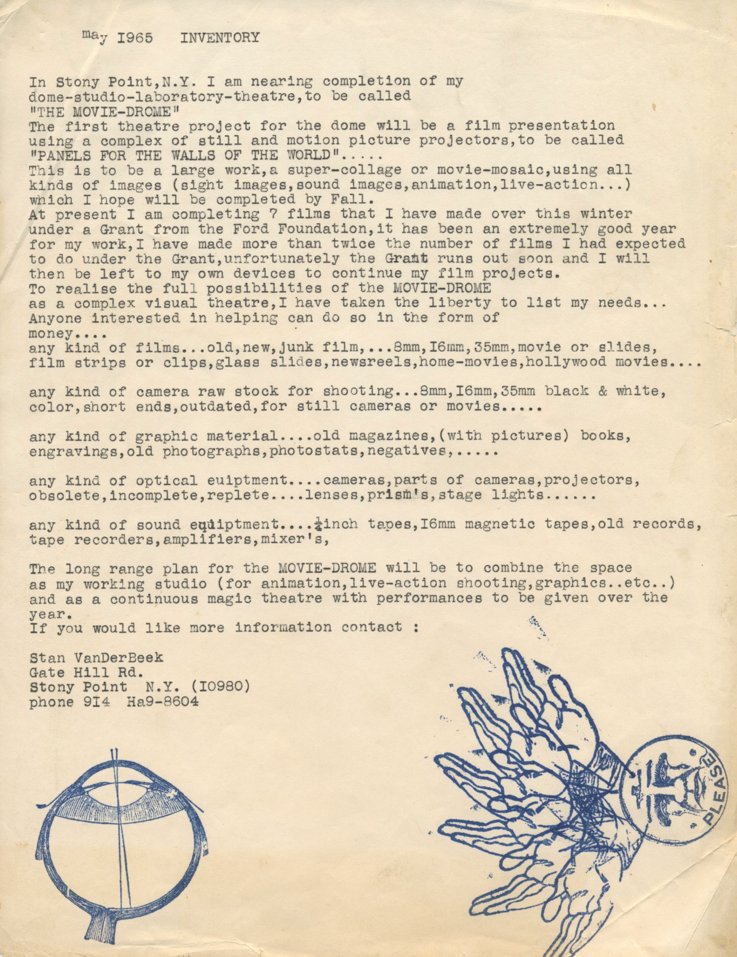
To ground Youngblood’s loose and speculative rubrics, I turned to Vanderbeek’s Movie-Drome (1964- 1965) which accurately predicted new media as a convergence of cinema and computing histories, and shed light on a cultural experience concerning informational systems of exchange. First displayed at an artists’ co-op deliberately outside of the art district of Manhattan, Movie Dromeis a 31ft tall hemispherical structure made from the repurposed top of a grain silo (Sutton, 2015). This location choice is a significant one, since it attempts to escape the formal white cube conditions. Simultaneously, it reflects the Expanded Cinema’s consciousness towards the environment of film, where the black box can exceed the theatre’s single screen and neatly seated audience. In other words, environment itself is also a part of the cinematic apparatus.
As the body enters, it finds itself contained and all immersed by a 360 degrees surrounding screen. The moving image comprises not of one single narrative, but of an overwhelming presence of collaged information including “collage films; computer films; newsreel and found; dance and performance films; and multiple slideshows combining original and found images” (Stan VanDerBeek Archive, n.d.). To the body, all sorts of image, sound and dialogue modalities come messily together, fracturing how the body absorbs and organizes information through the visual and auditory (Crary, 1990). Rejecting the formal silent contemplation of the gallery or cinema, this environment is engineered for sensory overload as of a similar case to teamLab Borderless (2024). However, VanDerBeek’s focus exceeds the attempted control of the individual’s sensory experiences within an art or film context. With Movie-Dromeas his first physical prototype (1964- 1965), he imagined that the body could expand its consciousness outside of the physical self within a system where information can be anywhere and everywhere, becoming relational within a social self. Notably, this is where discussions of the Expanded Cinemaalso shifts beyond a simple environment of bigger screens to a philosophical concept concerning how human consciousness evolves from the black box. Predating the invention of the Internet (Beard, 2023), VanDerBeek has effectively conceptualized a global interface for exchange where information is processed collectively. He calls this the ‘experience machine’ (Sutton, 2015).
Section 4: After The Experience Machine
It serves an interesting note that we are now living beyond VanDerBeek’s wildest imaginations envisioned by his experience machine or global media network. Just like Warhol’s contemporaries, the way that media is consumed has metamorphosized along the innovations of new consumer technologies. The moving image is no longer simply a fragmented and intimate experience resulting from the television, but a cultural token speaking of the highly atomized and increasingly personalized digital experience. What an obscene thought it would be to Hitchcock if the premiere of Psycho(1960) would be broadcasted live to an underground Facebook community! The invention of the smartphone and social networking systems, exemplified by Facebook, Instagram, Snapchat and BeReal, act as anchors for our modern culture wherein the exchange of information is expected to be effortless, instantaneous, to the point where technology becomes a seamless extension to our physical and social bodies. Beyond the limits of human consciousness VanDerBeek imagines, we live within a hyperconnected culture of online immediacy (Mathé, Bauwens & Verstrynge, 2025).
In relation to the immersive experience’s criticized lack of novelty as nothing beyond commercial entertainment (e.g. Desplanque, 2025), the culture of online immediacy plays two significant roles. Firstly, the art container needs to be designed to be attention-grabbing enough in a mass rather than niche sense in order to maximise commercial potential within our Experience Economy (Pine & Gilmore, 1998). Secondly, the multisensory experience or stimuli designed needs to accustom this contemporary’s expectations of being instantly stimulated and gratified. According to Kierkegaard’s existential philosophy, ‘aesthetic immediacy’ pertains to direct sensory experience that pertains to whatever please the senses (Mathé, Bauwens & Verstrynge, 2025). In other words, immediacy, according to Kierkegaard, needs to please the unreflective modes of rational minds that are spontaneous and sensuous. This may imply that the immersive experience desires not to please the formal eye that pursues an eternal class ideology as explored by O’Doherty (1999), but rather to feed an instantly gratifying mode of aesthetic encounter represented through a ‘more is more’ approach.
This alludes to Desplanque’s critique of the Vincent van Gogh immersive experience franchise (2025), whereby immersivity is employed as an artistic gimmick to make an overstimulating spectacle. By using moving projections and fluorescent lighting, the experience demands constant and more attention from the low-attention-span viewer who is accustomed to the “relentlessly [pursuing] [gaze]”, reducing art as mere entertainment in our era of sensory overload (Desplanque, 2025, p. 2). Furthermore, the experiential art audience is observed to engage art as popular media, a ‘like-grabbing’ “opportunity for selfies and group pictures, for instance, with a reconstruction of The Bedroom (1888) in their “photo room.” (Desplanque, 2025, p. 3). Implied, is the observation that bodies in the immersive experience remains highly controlled and disciplined through its sensuous and instant pleasure seeking mechanisms within our culture of online immediacy. This thus contemporizes the debates of Crary’s Techniques of the Observer (1992), as responsive components and new technologies produce convincing illusions specifically engineered for the modern mind.
In his chapter titled ‘Art, Entertainment, Entropy”, Youngblood has also perfectly foreshadowed the limited significance of the commercial immersive experience, which contrasts with the unlimited significance of art (1970, pp. 52- 65). Most relevant to the audio-visual adopted by the Vincent van Gogh immersive experience franchise (2025), Youngblood has predicted the rising of the ‘synesthetic cinema’, similar to the multisensory approaches of the modern immersive experience, as a paradox to the histories and dimensions of the expanded cinema (1970, p. 58). On the one hand, the concept emerges out of liberating cinema from its conventions, establishes a potential path for expanded consciousness. However, commercial abuse of this synesthetic dimension at the intersection of the body and technology can present a case of aesthetic overload, where information is designed to overwhelm the body for immediate sensuous or aesthetic gratification, making it an end to itself. This is furthered by the lens of thermodynamics, where he compares entertainment to the concept of ‘entropy’, a closed system that feeds energy back into itself, in the process degrading the trapped energy and never producing anything new (1970, pp. 59- 65).
What does this all tell us about how the modern-day immersive experience can avoid limited significance, and suggest potential for a new form of art container that effectively reflects and expands our cultural experience?
Section 5: The Bastard Son
Until this point, the paper has emerged understandings of the white cube and black box as separate histories that evolved in parallel. This strict zoning, that separates the evolution and ideology of the ultimate Modernist art container, and the paradigm shifts concerning how film transcends its medium and site into a deeper reflection and prediction of cultural experience, has allowed this paper to examine each of their complex social contracts and artistic meanings. It further allows an informed interpretation of the constituents and purposes of the immersive experience as a new art container that expands the body with technology.
Bridging the two zones, the key works of McCall from the 1970s onwards in the realms of ‘Structural’ film making represents one legitimate ‘marriage product’ born in between the white cube and black box. This intersection will then be literalized through Cardiff & Miller’s The Paradise Institute(2001) featuring a black box in the white cube, followed by the contemporary example of Pipilotti’s Your Palm is My Universeto contemplate upon meaningful expansion of the human consciousness through the immersive experience. This legitimacy of birth status, from its institutional belongings or final destinations, are then contrasted with the likes of teamLab’s immersive experiences, which is completely rejected by both institutional settings and venues in a completely external sense of authority, albeit a commercial one.
McCall’s ‘Structural’ Filmmaking
Frequenting screenings alongside fine artists at the London Film-makers Co-operative, McCall’s appreciation of film connects to influences of art, particularly through the relationship between film, sculpture and performance (Richard, 2012). From which, McCall’s understanding of ‘Structural’ film making is realized from deconstructing the material conditions of film through the lens of art; Or in Gidal’s terms, addressing the ‘tension between materialist flatness, grain, light, movement, and the supposed real reality that it represented’ (Richard, 2012, p. 3). To McCall, ‘Structural’ film making and the parallel movements concerning the expanded cinema proposes this chemistry or tension that he calls a ‘double helix’; “spiraling closely around one another without ever quite meeting” (Richard, 2012, p. 4). And for him, the challenge is to converge the two through a materialist approach. McCall’s Line Describing a Cone(1973) is most interestingly perceived as a historical intersection of film and sculpture, where he deconstructs the usually neglected material of film – the projected light behind the moving narrative screen – and turns it into a three-dimensional sculpture. The work is simple. It consists of a single projected white dot that gradually traces a circular arc on the screen; and as the arc completes its rotation, it forms a full circle. What is notable is that the cone of light maps out a dynamic visage where smoke and dust flows and fades, imbuing the ‘sculpture’ with an almost tactile quality that exists inside the space. To the navigating audience that is liberated from the static experiences inside the traditional cinema theatre, the aesthetic encounter mirrors the viewing experience of a performance or sculpture in a formal gallery. By deconstructing the art material of the film apparatus, McCall raises emerging questions concerning what film can be to the white cube.
Ironically, Line Describing a Cone(1973)’s failure at the Serpentine Gallery in 1973 reflects why the highly controlled environment of the white cube can both physically and symbolically restrict new concepts. During this exhibition, the “unshadowed, white, clean, artificial” conditions of the art container described by O’Doherty created an underwhelmingly low contrast and pristine environment (1999), that prevented the smoke and particles that were crucial in the conditions of the concept from substantiating and taking form. The work became flat and underwhelming, pushing its creator into an existential crisis marked by a two-decade long hiatus. As Richard argues, it had been the slightly dirty and casual conditions of the underground art container that gave McCall’s work its unique sense of life (2012). Art containers outside of the formal gallery or white cube may be observed to contain unique conditions or audiences that help to shape and evolve the conditions of what we know to be ‘art’. As such, the white cube in its environment but also ideology may not always be equipped or sufficient to encapsulate evolving new media or concepts.
Cardiff & Miller’s Double Enclosure
If McCall speaks of a conceptual negotiation between the black box and the white cube, then Cardiff & Miller’s The Paradise Institute (2001) offers a much more literal interpretation. Displayed in a white cube, this work features a claustrophobic theatre-box like structure constructed from the light and DIY-commanded material of plywood. Ursokie notices that this form of ‘double enclosure’ where a black box is literally constructed inside a white box proposes a strange and slightly odd marital product, “[evoking] a social space whose conventions are distinct from those of the art gallery or museum” (2014, p. 2). As this strange double enclosure, it further suggests that the modern state of institutional spaces have long evolved from the strict zoning away from theatrical components, and the white cube has formally consumed and absorbed and made mainstream the initially underground ideologies of the likes of Mekas, VanDerBeek and McCall.
Beyond Immediate Sensations
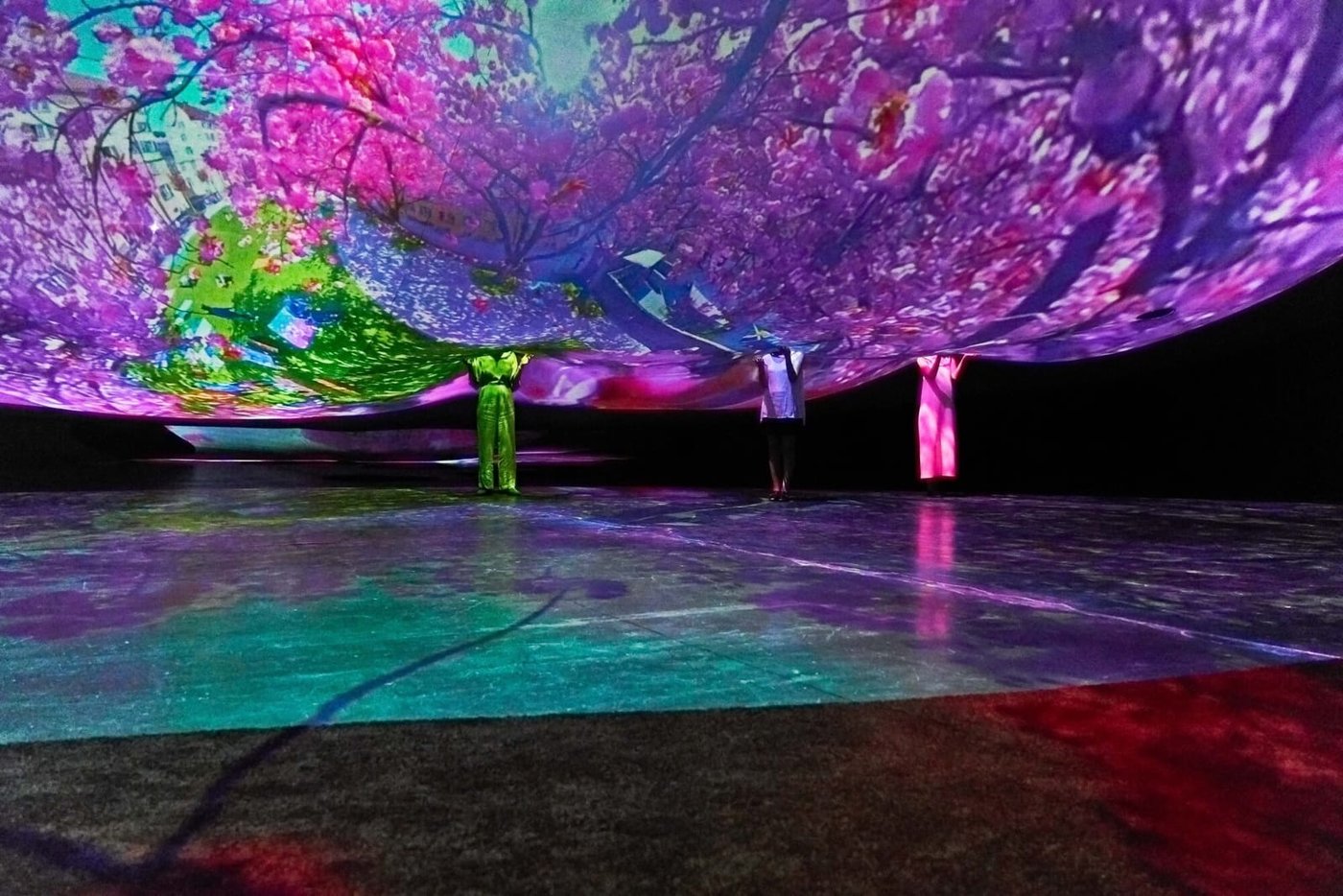
As one of the few contemporary cases within this paper, Pipilotti Rist’s Your Palm is My Universe (2025) finally turns the attention back to the immersive qualities currently being embraced by this strange convergence born in between the white cube and black box. For this work, Rist imagines that the containing space embodies a living body itself, holding memories of nature and the visitor a part of its interconnected system. As the body enters this space spanning 1,800 square meters, it enters under draping translucent fabrics that act as projection surfaces, hanging down from the ceiling. The eye sees projected visuals that are warped and distorted by the uneven fabrics, destabilizing fixed viewpoints and inverting perceptions. This experience is furthered by an experimental sound composition by Surma, thus engaging the auditory senses of the body. As a core part to the immersive experience, the visitor is encouraged to “lift and shift these layers, actively shaping their experience and those of others around them, underscoring the communal nature of perception” (Critical Playground, 2025). This work is thus designed to be aesthetically and immediately immersive through an almost formulaic approach, as the visual, auditory and tactile senses are engaged to create an immersive experience.
As immersive products became ubiquitously absorbed into formal art spaces and even producing new definitions of art containers around 2004, scholars have argued that the interactive components that define most immersive experiences have lost its novelty and impact within art (Zhou, 2024). Evolving from McCall’s first underground display of Line Describing a Cone(1973) whereby light or projective media felt unconventional and foreign to the formal white cube, Huhtamo states that today interactive media is everywhere, and its subsequents forms have become commonplace (2007). An interpretation of this argument, then, is that the mainstream art container and its related forms have evolved to maintain new flows of attention and money through different, interactive means. This crisis of interactive art and media also concerns the lack of conceptual depth (Guljajeva, 2018), and overused strategies that makes it no longer special (Dieters, n.d.; Kluszczynski, 2010). Thus, the construction of immersive experiences seem to rely on a tick-a-box and formulaic approach, that relies on the technological front in diluting conceptual depth.
In defense of artistic potentials of interactive components, Zhou argues that the field is insufficiently explored (2024). By focusing on the three dimensions of body embodiment, bodily sensation (i.e., somaesthetic) and audience-artwork interaction, a new three-dimensional descriptive model has been applied to dissect and provide framework understandings of 49 award-winning interactive artworks from the Prix Ars Electronica (2009–2023) (2024). I highlight here two main findings that infer the immersive experience as under-explored and under-experimented by both academia and contemporary art practice.
Firstly, according to Zhang, the corpus reveals that the audience-artwork interaction constructs on more passive than active grounds of engagement, implying a tendency towards unidirectional and disciplined conditions whereby the audience perceives more than they participate (2024, p.21). Secondly, the sample also reveals an overwhelming reliance on the visual sensation to engage audience perception (45 out of 49 artworks); with reliance on the auditive sensation ranking in second (37 out of 49 artworks) (Zhang, 2024, pp. 21-23). Now the other senses mentioned, including the tactile, vibratory, pain, temperature, olfactory and gustative sensations have been critically underemployed by artists, with 0 out of 49 artworks employing the olfactory and gustative senses in the past 15 years of the Prix Ars Electronica awards for Interactive Arts. This may render Rist (2025)’s approach to the immersive experience a relatively successful one from the perspective of embodiment, due to its effective outcome in connecting the tactile touch to their intricate theme of bodily interconnection. On the other hand, it contributes the artistic failure of the Vincent van Gogh franchise (2017), by limiting its immersive qualities to the typical visual and auditive sensations. Although this study focuses on award winning artworks rather than immersive experiences specifically - which connotes a stronger function and consideration of site or environment -, there is a profound implication that non-visual and non-auditory engagements, alongside active participation, need to be explored in conjunction with the use of space in immersive experiences.
Conclusively, interactive components currently experience a lack of variety making them somewhat predictable. Engaging full dimensions of senses and active participation foreshadows a more successful approach to the modern immersive experience, further negotiating and shifting towards Youngblood’s original visions for the expanded cinema, from entertainment back into the realms and considerations of art (1970).
The Bastard Son
Unlike the former examples, teamLab (f. 2001) emerged separate from the Western art canon an international art collective that started as a university project by several University of Tokyo students. Today, the collective is known for its international talents across the art and science fields as well as their unique immersive experiences that have drawn upon Eastern relational ontology and philosophies (e.g. En Teahouse, 2024). Quoted as ‘the most visited museum (single art group)’ of the year (Guinness World Record, 2024), it registers a widely spreading commercial and public interest to the immersive subject. What makes this bastard son – a strange DIY project-turned institution that emerged between the histories of art and film, yet culturally disassociated from the direct histories of the white box and black cube – so popular? Partially, this reflects the economic restructuring into the ‘experience economy’, where consumer focuses on meaningful experiences rather than traditional goods or services. As Pine & Gilmore argues, the deliberate design of experiences has evolved as a distinct economic offering for not only companies but also in cultural planning (1998). In the art world, this economic restructuring as resulted in not only adaption of immersivity into traditional models, such as virtual systems and extended reality technologies (Shehade & Stylianou-Lambert, 2020), but also the blooming successes of more experimental art experiences promoted by newer institutions such as teamLab. Giannini & Bowen also argues that the immersive turn is also a reflection of the digital surge and changing modes of visitor expectaions after COVID-19 (2021). Additionally, this paper has also touched upon the significant connections between our culture of immediacy and how these newer immersive experiences are designed to control the modern body, tracing back to the Kierkegaardian definition of ‘aesthetic immediacy’ and Crary’s understanding between the body and technological control.
Due to its bastardly status, teamLab is somewhat freed from certain conventions that evolved from the canonical taxonomies of art. Although it can be argued that teamLab does not consciously intend to embody resistance to the traditional forms, its methods and strategies have quite successfully negotiated new social and material contracts that reify the anti-institutional ethos born from the white cube and black box. For instance, teamLab has established a fully viable commercial system that allows art to be consumed as an experience rather than a luxury object, whilst the profit returns are sufficient for the collective to continue their establishment and innovate the immersive experiences they provide. Essentially, this allows them to dissolve the individual genius to a collective form, albeit challenging VanDerBeek’s binary distinctions between art and entertainment. As signified in O’Doherty’s critique of the white cube (1999), standardized art making and containing methods propose an obstacle to true creativity. New art containers are beneficial because they do not need to abide by the conventions and disciplines of the formal conventions. However, it may emerge as a prediction that the growth in scale of the company may impede on teamLab’s motivations to continue innovating and crafting meaningful experiences outside of the canonical fashion. As an earlier example, McCall has demonstrated the symbolic and environmental limitations of one institution may evolve and then fully absorb those unconventional approaches back into the mainstream institution. As such, teamLab can only function as an ideology as long as its leaders stay true to a pursuit of innovation and creativity.
Furthermore, immersive experiences offered by the likes of teamLab should not be restricted to a formulaic and conceptually void understanding of immersivity. Technologically, non-visual and non-auditory sensations need to be further explored in order to expand its innovative capacities. Repetitive works that feature visual and auditory illusions, as witnessed in teamLab’s Borderless(2024), need to be exceeded beyond. The mostly passive forms of participation within their works will also be empowered by an increasingly active approach, deepened by a social or cultural concept. It may be interesting for future research to analyze the organizational models of teamLab in order to determine how artistic decisions are made and negotiated, as well as the power distribution between art directors and newer staff.
Although deeper tensions may still remain in this negotiation between commercial entertainment and art, teamLab demonstrates a hopeful possibility in challenging conventional approaches and taxonomies evolved from the histories of the white cube and black box.
Conclusion
Conclusively, this paper has positioned the immersive experience as a new form of art container that evolved in between the parallel histories of the white cube and black box, despite lack of a formal lineage in canonical art history, and its criticized spectacular conditions. This radical or perhaps even ignorant positioning considers how art has long negotiated, reflected and even predicted evolving tensions between the body and technology in the expanded fields of art (e.g. Kaprow, 1959; O’Doherty, 1999; Crary, 1990; VanDerBeek, 1964-1965; McCall, 1973). As contemporaries living within desires instrumentalized by the hyper development of technologies, the trajectory of this new form of art containment needs to be understood in relation to how modern technologies epitomized by a culture of immediacy has evolved in the making of new history.
Notes
1. albeit evolved out of a Japanese art context rather than the canonical one.
2. teamLab emerged in 2001 by a group of Tokyo University graduates (Stokes-Rees & Moskowitz, 2019)
Bibliography
180 Studios (2025) Paradigm Shift. Available at: https://www.180studios.com/paradigm-shift (Accessed: 19 November 2025).
Ascott, R. (1970) ‘Behaviourist Art and the Cybernetic Vision’, Cybernetica, 13(3), pp. 109–121.
Barnes, P. and McPherson, G. (2019) ‘Co-creating, co-producing and connecting: Museum practice today’, Curator: The Museum Journal, 62(2), pp. 145–162. Available at: https://doi.org/10.1111/cura.12309
Beard, T. (2023) ‘On Expanded Cinema by Gene Youngblood’, Artforum, 13 October. Available at: https://www.artforum.com/columns/thomas-beard-on-gene-youngbloods-expanded-cinema-246575/ (Accessed: 25 October 2025).
Bishop, C. (2018) Black Box, White Cube, Gray Zone: Dance Exhibitions and Audience Attention. CUNY Academic Works. Available at: https://academicworks.cuny.edu/cgi/viewcontent.cgi?article=2193&context=gc_pubs (Accessed: 12 November 2025).
Bourdieu, P. (1984) Distinction: A Social Critique of the Judgement of Taste. Cambridge, MA: Harvard University Press.
Capper, E.R. (2025) ‘Modernist Pedagogies in Allan Kaprow’s 18 Happenings in 6 Parts’, Selva: A Journal of the History of Art, 6.
Crary, J. (1990) Techniques of the Observer: On Vision and Modernity in the Nineteenth Century. Cambridge, MA: MIT Press.
Critical Playground (2025) ‘Your Palm is My Universe, Pipilotti Rist and the Shape of Immersion’, Critical Playground, 31 August. Available at: https://criticalplayground.org/featured/your-palm-is-my-universe-pipilotti-rist-and-the-shape-of-immersion/ (Accessed: 2 November 2025).
Daniels, D. (2008) ‘Strategies of interactivity’, in Sommerer, C., Jain, L.C. and Mignonneau, L. (eds.) The Art and Science of Interface and Interaction Design. Berlin: Springer, pp. 27–62.
Daniels, D. (n.d.) Strategies of Interactivity. Available at: https://www.hgb-leipzig.de/daniels/vom-readymade-zum-cyberspace/strategies_of_interactivity.html (Accessed: 27 October 2025).
De’, R., Pandey, N. and Pal, A. (2020) ‘Impact of digital surge during Covid-19 pandemic: A viewpoint on research and practice’, International Journal of Information Management, 55, 102171. Available at: https://doi.org/10.1016/j.ijinfomgt.2020.102171
Deleuze, G. and Guattari, F. (1987) A Thousand Plateaus: Capitalism and Schizophrenia. Translated by B. Massumi. Minneapolis: University of Minnesota Press.
Desplanque, K. (2023) ‘Van Gogh: The Immersive Experience: A Review’, Journal18, Issue 16. Available at: https://www.journal18.org/nq/van-gogh-the-immersive-experience-a-review-by-kathryn-desplanque/ (Accessed: 18 November 2025)
Foucault, M. (1977) Discipline and Punish: The Birth of the Prison. Translated by A. Sheridan. London: Allen Lane.
Freud, S. (1900) The Interpretation of Dreams. In: Strachey, J. (ed.) The Standard Edition of the Complete Psychological Works of Sigmund Freud, Vols. 4–5. London: Hogarth Press.
Gao, Z. (2022) ‘The application of AR and VR in museum education and cultural heritage preservation’, Advances in Social Science, Education and Humanities Research, 678, pp. 122–128. Available at: https://doi.org/10.2991/assehr.k.220105.022
Giannachi, G. (2021) ‘Into the Space of the Digital Museum’, in Franco, S. and Giannachi, G. (eds.) Moving Spaces: Enacting Dance, Performance and the Digital in the Museum. Venice: Edizioni Ca’ Foscari, pp. 119–134.
Goethe, J.W. von (1840) Theory of Colours. Translated by C.L. Eastlake. London: John Murray.
Gopnik, B. (2017) ‘Andy Warhol, Sleep (1963)’, The Brooklyn Rail, 1 September. Available at: https://brooklynrail.org/2017/09/criticspage/Andy-Warhol-Sleep-1963/ (Accessed: 24 October 2025).
Guinness World Records (2019) ‘Most visited museum (single art group)’. Guinness World Records. Available at: https://www.guinnessworldrecords.com/world-records/589898-most-visited-museum-single-art-group (Accessed: 30 October 2025).
Guljajeva, V. (2018) From Interaction to Post-Participation: The Disappearing Role of the Active Participant. Tallinn: Estonian Academy of Arts.
Heardman, A. (2023) ‘Against Immersion’, Art Monthly, 467 (June). Available at: https://www.artmonthly.co.uk/magazine/site/article/against-immersion-by-adam-heardman-june-2023 (Accessed: 15 November 2025).
Hertz, A., Mokady, R., Tenenbaum, J. et al. (2022) ‘Prompt-to-Prompt Image Editing with Cross-Attention Control’, arXiv preprint arXiv:2208.01626. Available at: https://arxiv.org/abs/2208.01626 (Accessed: 6 November 2025).
Hitchcock, A. (1960) Psycho[Film]. USA: Paramount Pictures.
Huhtamo, E. (2009) ‘The Sky is (not) the Limit: Envisioning the Ultimate Public Media Display’, Journal of Visual Culture, 8(3), pp. 329–348. Available at: https://doi.org/10.1177/1470412910364291
Iwai, D. (2024) ‘Projection mapping leaves the darkness behind’, Osaka University Research News. Available at: https://resou.osaka-u.ac.jp/en/research/2024/20240315_1 (Accessed: 17 November 2025).
King, E. (2021) ‘Digital responses of UK museum exhibitions to the COVID-19 pandemic’, Curator: The Museum Journal, 64(4), pp. 517–533. Available at: https://doi.org/10.1111/cura.12418
Kluszczynski, R.W. (2010) ‘Strategies of Interactive Art’, Journal of Aesthetics & Culture, 2(1), pp. 1–27. Available at: https://doi.org/10.3402/jac.v2i0.5525
Kühnapfel, C., Fingerhut, J. and Pelowski, M. (2023) ‘The role of the body in the experience of installation art: a case study of visitors’ bodily, emotional, and transformative experiences in Tomás Saraceno’s “in orbit”’, Frontiers in Psychology, 14, 1192689. Available at: https://doi.org/10.3389/fpsyg.2023.1192689
Kwastek, K. (2013) Aesthetics of Interaction in Digital Art. Cambridge, MA: MIT Press.
Kwon, H., Choi, Y., Zhao, X., Min, H., Wang, W., Garaj, V. and Lam, B. (2025) ‘How immersive and interactive technologies affect the user experience and cultural exchange in the museum and gallery sector’, The International Journal of the Inclusive Museum, 18(1), pp. 135–160. Available at: https://doi.org/10.18848/1835-2014/CGP/v18i01/135-160
Li, J., Wider, W., Ochiai, Y. and Fauzi, M.A. (2023) ‘A bibliometric analysis of immersive technology in museum exhibitions: exploring user experience’, Frontiers in Virtual Reality, 4, 1240562. Available at: https://doi.org/10.3389/frvir.2023.1240562
Mathé, J.J., Bauwens, J. and Verstrynge, K. (2025) ‘Being and becoming in the culture of immediacy: An existential-ethical approach’, New Media & Society, 27(11), pp. 1–21. Available at: https://researchportal.vub.be/en/publications/being-and-becoming-in-the-culture-of-immediacy-an-existential-eth/
Mekas, J. (1972) Movie Journal: The Rise of a New American Cinema, 1959–1971. New York: Macmillan.
Pine, B.J. II and Gilmore, J.H. (1998) ‘Welcome to the experience economy’, Harvard Business Review, July–August. Available at: https://hbr.org/1998/07/welcome-to-the-experience-economy (Accessed: 18 November 2025).
Richard, L. (2012) ‘Anthony McCall: The Long Shadow of Ambient Light’, Oxford Art Journal, 35(2), pp. 251–283. Available at: https://doi.org/10.1093/oxartj/kcs013
Slater, M., Lotto, B., Arnold, M.M. and Sanchez-Vives, M.V. (2009) ‘How we experience immersive virtual environments: The concept of presence and its measurement’, Anuario de Psicología, 40, pp. 193–210.
Stan VanDerBeek Archive (n.d.) ‘Stan VanDerBeek, Movie-Drome, 1965’. Available at: https://www.stanvanderbeekarchive.com/artists/tFzRGnN/stan-vanderbeek/SmTa8j6/stan-vanderbeek-movie-drome-1965/ (Accessed: 7 November 2025).
Stokes-Rees, E. (2019) ‘Exhibition without Boundaries: teamLab Borderless and the Digital Evolution of Gallery Space’, Museum Worlds, 7, pp. 238–249. Available at: https://doi.org/10.3167/armw.2019.070116
Shehade, M. and Stylianou-Lambert, T. (2020) ‘Virtual reality in museums: Exploring the experiences of museum professionals’, Applied Sciences, 10(11), 4031. Available at: https://doi.org/10.3390/app10114031
Sutton, G. (2015) The Experience Machine: Stan VanDerBeek’s Movie-Drome and Expanded Cinema. Cambridge, MA: MIT Press.
Tang, Q., Zheng, L., Chen, Y., Yan, L. and Chen, J. (2024) ‘Artificial intelligence empowering museum space layout design: Insights from China’, PLOS ONE, 19(11), e0310594. Available at: https://doi.org/10.1371/journal.pone.0310594
teamLab (2024) EN TEA HOUSE Genka-tei, Azabudai Hills. Available at: https://en-tea-house.teamlab.art/jp/azabudai/ (Accessed: 31 October 2025).
teamLab (2024) ‘teamLab Borderless: MORI Building DIGITAL ART MUSEUM’. Available at: https://www.teamlab.art/e/tokyo/ (Accessed: 30 October 2025).
Uroskie, A.V. (2014) Between the Black Box and the White Cube: Expanded Cinema and Postwar Art. Chicago, IL: University of Chicago Press.
Wheatstone, C. (1838) ‘Contributions to the physiology of vision.—Part the first. On some remarkable, and hitherto unobserved, phenomena of binocular vision’, Philosophical Transactions of the Royal Society of London, 128, pp. 371–394. Available at: https://doi.org/10.1098/rstl.1838.0019
Williams, R. (1974) Television: Technology and Cultural Form. London: Fontana.
Youngblood, G. (1970) Expanded Cinema. New York: E.P. Dutton.
Zhang, Y. and Huang, X. (2024) ‘Integrating extended reality (XR) in architectural design education: A systematic review and case study at Southeast University (China)’, Buildings, 14(12), 3954. Available at: https://doi.org/10.3390/buildings14123954
Zhou, A.L. (2024) ‘Inflation of interactivity? Analyzing and understanding embodied interaction in interactive art through a new three-dimensional model’, arXiv preprint arXiv:2409.00047. Available at: https://arxiv.org/abs/2409.00047 (Accessed: 29 October 2025).
Image Reference
Casper Mueller Kneer Architects (2011) White Cube Bermondsey, London: Architectural interior. Photograph. Available at: https://www.archdaily.com/256103/white-cube-bermondsey-casper-mueller-kneer-architects (Accessed: 31 October 2025).
Trouillot, T. (2023) Letter from VanDerBeek about completion of Movie-Drome, 1965. Photograph. Available at: https://www.moma.org/magazine/articles/845 (Accessed: 25 November 2025).
Critical Playground (2025) Your Palm Is My Universe. Photograph. Available at: https://criticalplayground.org/featured/your-palm-is-my-universe-pipilotti-rist-and-the-shape-of-immersion/(Accessed: 2 November 2025).